Podcasts
Podcasts
-
Transcript - Podcast - Becoming Marilyn
Norma Jeane and Gladys
He's not that loud, Norma. Gladys, my mother. The slightest noise makes her nervous. With us, everything always ends in screams and tears. Like in bad movies, marriages fail, spouses disappear, men go crazy and die, women survive alone. They no longer know how to bond with their children. I am fighting to reverse this story.
I want to change things. I want to dream. I don't want to be like mom. I want to play. Welcome to my home. My first house. My mother borrowed to buy it. I move in with her. It's a party every day. It drinks, dances, sings, but beyond the limits. I secretly pray that my mother and her friends don't end up in the offer. But God never listens to me.
The house then the orphanage
Mom can no longer repay her loan. She's going crazy. I land at the orphanage. I send postcards to myself, signed by Mom and Dad. I send myself postcards. I send myself postcards. I send myself postcards. I send myself postcards. I send myself postcards. I send myself postcards. I send myself postcards. I send myself postcards. I signed mom and dad.
Building Marilyn
I feel less alone when I imagine another life. Less sinister. The only thing I miss is love. My name is Marilyn Monroe. I'm building Marilyn. I can be an ordinary girl in jeans and a shirt and transform into Marilyn in the blink of an eye. It's great to be a sex symbol, to slip into people's subconscious.
But I want to be loved for who I am. I am an interpreter. I don't care about the money. I love Maria Ella, Billie Holiday. I just want to be wonderful. At times she was happy. Drunk with happiness. Marilyn belongs to the truckers, to the soldiers, to the whole world. And now to you. I couldn't get rid of her. But find out.
-
Transcript - Podcast - An icon in Korea
The scene in Korea
... We are in Korea in 1954. You are all G.I.s. It's my honeymoon and you are my greatest gift. 60,000 men whistling their lungs out. On this stage, no more coaches, no more studio bosses, no more jealous husbands, no more people to tell me what I should do. I am alone in the centre.
There in Korea, with them, for the first time, I am no longer afraid. I sing. I dance for them. The house we live in has not been our home for a long time. And I'll take care of it and I'll go away. I swear to you. Marilyn, can I ask you a personal question? Whatever you want. You will answer me in all sincerity. Yes.
Were you thinking about sex while We were playing? I didn't think about it at all. Didn't you have any image of hugging or kissing in your mind? None. I was completely focused on our lines. I believe you. You always tell the truth. To you, yes. It's very strange.
The question of gambling
The entire time you were performing this scene, I kept feeling sexual vibrations emanating from you, as if you were a woman in the throes of passion. I stopped because I thought you must be too consumed with sex to continue. I now understand the problems you may have in the studio, Marilyn.
You actually emit sexual vibrations, whatever you are doing or thinking. The whole world responded to these vibrations. They will be transmitted by the cinema screens when you appear there. And your big bosses are only interested in your sexual vibes. They are enough to bring them a fortune. This is why they refuse to consider you as an actress.
Becoming an artist
All they want is to take advantage of the sexual stimulant that you are. Their motives and plans are very clear. It's true. Just by appearing on the screen, without bothering to play, you could strike gold. But there is no question of that. For what ? I want to become an artist not an erotic gadget. I don't want to be sold to the public as an aphrodisiac on Film.
Look at me, start shaking. It was acceptable for the first few years. But this time things have changed. I won't just show up on set when I'm called to. I will fight for the right to be myself and use my talents. I don't want to become a commodity to be sold in cinema windows.
I want to be an artist but for a toy I need everyone's help. I will do everything. I want to be an artist but I don't know what hurts me. I want to be a custom and make gold. Also, I want to be an artist. From another point of view, I feel like I'm the most important artist. I have all the little ones
-
Transcript - Podcast - Kennedy and me
Happy birthday, Mr. President
Happy birthday, Mr. President. Thanks John. You and I are the biggest buzz of the century for unscrupulous journalists, a bestseller, a source of inspiration for authors seeking notoriety. It seems to be a tumultuous affair where I am most often drunk and drugged. A victim, a poor girl. You love it.
A social relationship
But sorry to disappoint you, between October 61 and August 62, the president and I met four times. There are always people around us. Except once, I phone Ralph, my masseur. The president has a back pain. Ralph gives me advice. Two hours alone at Bing Crosby's ranch. I am in very good shape, the president too.
Rumors and Politics
He invites me to his birthday party at Madison Square Garden. I promise to be there. Two hours where I am his first lady and he is my president. A worldly relationship. But for nothing in the world, I wouldn't have wanted it to drag on. Where is the male? And the handsome kids? We are talking about civil rights, motor rights.
-
Transcript - Podcast - My death and after...
Fox and the savings
Will it make money or not? The filming of Cleopatra, 30 million dollars, it ruins Fox, Fox sells entire sections of the studio, no more drama schools, no more management schools, no more lawn watering, no more sparrows. You have to save money. I don't let it happen. And contrary to what people say, I'm doing well.
But on Saturday August 4, in 25 minutes, everything changed. At 7:15 p.m., I'm happy. I'm speaking with Tim Adio Junior. I have plans. I'm moving forward. My troubles are behind me. I'm finally going to let it pass and live before I'm too old. At 7:40 p.m. I'm speaking with Peter Loford and mid-sentence. I feel it. She is there. She is there. I fly away slowly.
August 4
Towards death. No. I didn't commit suicide. I wasn't killed by Hollywood or the Kennedys. Nor by the mafia. Nor by extraterrestrials. It was my dear doctors who killed me. They shoot me. They fill me with pills. These pills, I ask them. I need it. It's good. I have it close. How much ? I don't know anymore. Probably a few too many. 5:35 a.m.
A pink wool blanket covers my body. A metal cart, straps, my garden path. I'm loaded into an old Ford van. Jody Maggio is here. He wants to bring me back to life. Alan does my final makeup. Joe watches over me all night. We love each other. Every week, for 20 years, he had flowers brought to my grave. He will not remarry.
After death
He will never say my name again. Tchaikovsky's sixth symphony. Auvers le Rimbaud, my favorite song. The words of Lee Strasberg. The dreams of his talent were not a mirage. 30 friends at my funeral. Hollywood is not invited. Mom's not here. She will never learn of my death. Life seems simpler to me. I made it a lot complicated for myself.
All night long, the clicking of cameras and the noise of photographers. What do they photograph? I'm still here. Maybe. Where am I? Listen to your dreams. Don't be afraid. Act, dance. Before it's too late. Listen to your dreams. Don't be afraid. Act, dance. Before it's too late. Listen to your dreams. Don't be afraid. Act, dance. Before it's too late.
-
Transcript - Podcast - The Archives
Milton Greene
Milton Greene is a photographer. For years, millions of us have seen his images on the covers of Look, Life, Vogue and other magazines. Thirty-three-year-old Milton, his wife, and their one-year-old son live in this one-hundred-and-fifty-year-old house in Weston, Connecticut. It's about an hour's drive from his studio in Manhattan. Milton Greene was my mentor.
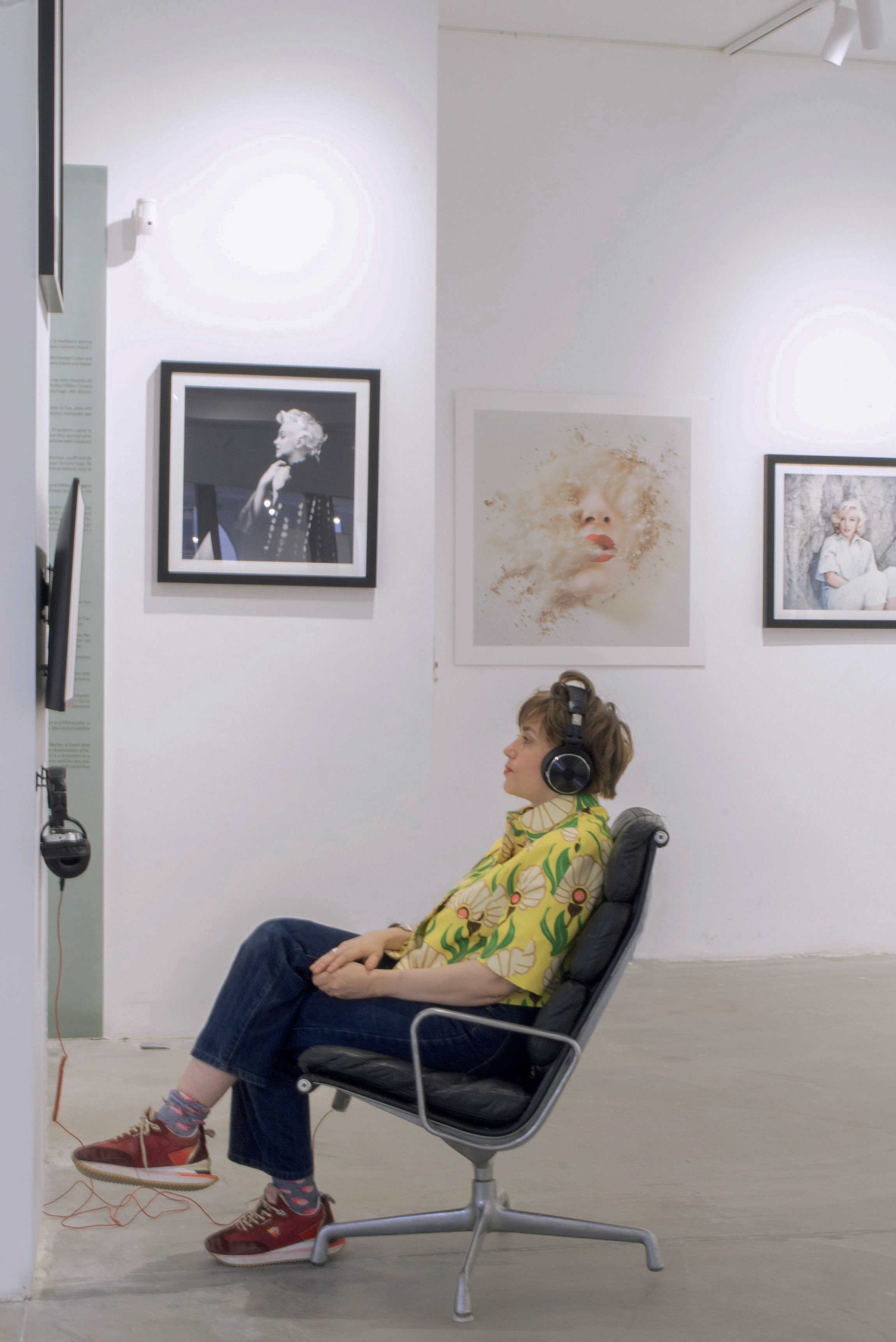
He was my best friend: growing up around him, learning photography with him, learning to shoot images with him. When I decided to put away my devices and enter the restaurant business, it was out of love for my father. He died heartbroken that some of the best work he ever did was never published, never seen, and could never be reproduced.
When I discovered digital, I saw the opportunity to bring my father back to me, and to bring photos back to the world. I think it's important to capture these images as well as the technology allows. Technology continues to change, so sometimes we start over and over again. There are only a limited number of photographs: four thousand in the entire collaboration between Milton Greene and Marilyn Monroe.
Restore Images
Let's work on all the ones we can. What we do is go into the image and capture the eye, the lips, making sure we retain detail in the highlights and in the shadows. We therefore export from FlexColor, the software supplied with the scanner, to Photoshop. From start to finish, this averages forty to sixty hours, depending on the image.
Most of the cleaning is done pixel by pixel with the correction tool. This can take thirty to forty hours of work. What people don't really measure is the level of detail of this work; when you really manipulate these pixels, you have to be careful not to create a digital scar. Here we see the state of the film.
This is dust embedded on the surface of the film. A scratch here, some scratches there. These are small things, but see how it interferes with the hair. It's all there. Rav drew a clipping, then softened it according to the softness of the film. Once I have the mask, it allows me to choose which colour correction layer tools I'm going to use.
Masks and prints
Most of the time, it will be a choice between hue and saturation, curves and selective correction. Sometimes there will be two or three adjustment layers with a mask. Other times there can be as many as six. On the face and hair, getting the right colours requires more control with masks.
We'll probably print seven proofs to feel how the image prints and how it looks on screen, because the screen gives a lot more information than you can really get on paper. But I need to see the prints enlarged to really see the edges of the masks, how they merge, and if there is an error that needs to be corrected.
When I was eleven, my father put me in the darkroom and taught me how to shoot. His way of approaching the image, what he wanted to strengthen, darken, retain or control, made it possible to get the best out of the image. The print therefore ended up looking different from the original completed piece of film. That's what a fine art printer does: they bring another layer of expertise so that the print holds up on its own.
The original Look magazine commission that led Milton to photograph Marilyn was actually to photograph several promising young talents in Hollywood. Look editors presented Milton's portfolio to Marilyn. When she saw his photographs, she was very excited to work with him.
Marilyn in front of the camera
They met in California and did the mandolin and negligee session on the first day. Watching the films the next morning, Marilyn saw in Milton's photograph a part of herself that was real. He would never have let anyone see a bad photo if he had taken one, and she could believe he was protective.
This is how their relationship as photographer and muse was built. In the months that followed, Milton returned to California to photograph Marilyn. They would go to the costume department at 20th Century Fox, put on a fancy outfit, then go off to shoot on the outdoor sets. Over a short period, we see photographs of Marilyn playing dress-up, whether she is a peasant, a gypsy or a prostitute.
There is an element of fantasy and pleasure in their collaboration. They were having fun. It was make-believe. All Milton wanted to do was prove that she could be the composing actress she wanted to be, and build her confidence.